

For centuries, the red planet of Mars was considered a cold, arid desert completely devoid of liquid water and biological activity. However, groundbreaking scientific advancements, satellite radar mapping, and robotic rover missions over the past decade have fundamentally transformed our understanding of Martian geology.
Recent astronomical evidence confirms that vast quantities of water exist on Mars—primarily trapped in polar ice caps, buried deep in subsurface glaciers, and bound within hydrated minerals across the planet’s crust.
This momentous scientific breakthrough is not merely an academic triumph; it serves as the foundational cornerstone for future crewed space missions and the long-term feasibility of human colonization beyond Earth.
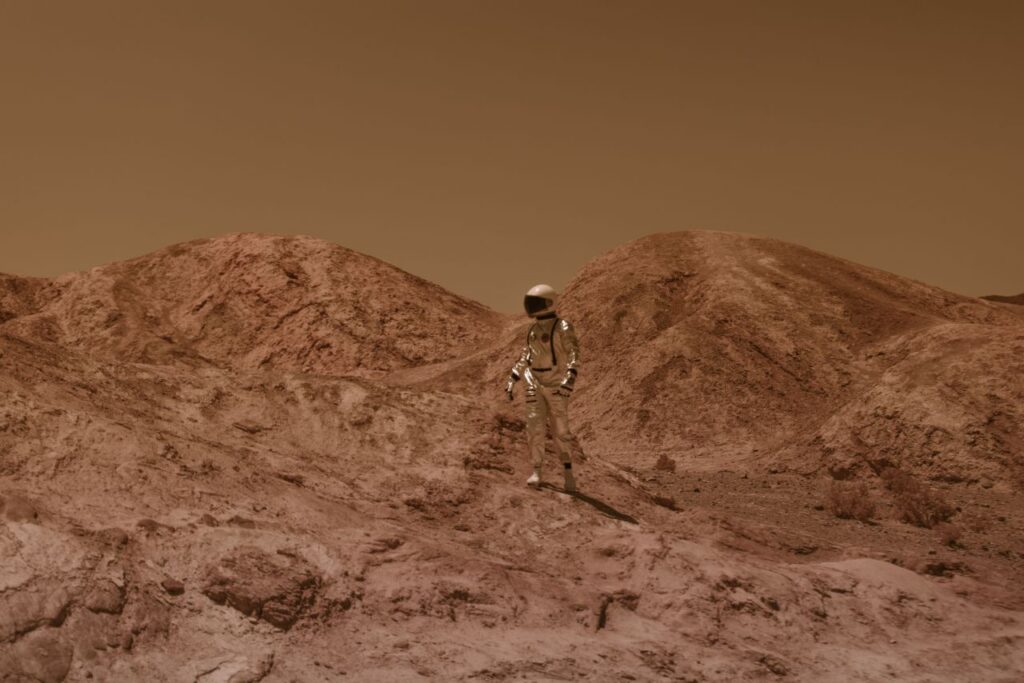
The Evolution of Water Discoveries on the Red Planet
The quest to identify water on Mars began with early flyby missions that captured images of ancient riverbeds and dry lake basins, hinting at a warmer, wetter past. Modern planetary science has since progressed from observing historical erosion patterns to actively analyzing real-time subsurface water reserves.
1. Subsurface Ice Sheets and Glaciers
Using advanced radar instruments aboard orbiting spacecraft, planetary scientists have detected extensive ice sheets beneath the Martian regolith. In many mid-latitude regions, pure water ice lies just a few meters beneath the soil surface, protected from atmospheric sublimation by thin layers of dust.
2. Hydrated Minerals and Clay Deposits
Robotic rovers, including NASA’s Curiosity and Perseverance, have analyzed rock samples containing clay minerals and hydrated salts. These geological samples prove that liquid water persisted on Mars for hundreds of millions of years, forming stable lakes and ancient river systems capable of hosting microbial life.
According to research data published directly by NASA, the presence of accessible subsurface ice significantly reduces the mass payload required for future deep-space human expeditions.
Why Martian Water Is Vital for Human Survival
Sustaining human life on another planet requires solving three fundamental survival challenges: breathable oxygen, drinking water, and fuel production. Water discovered on Mars directly addresses all three necessities through basic chemical engineering.
1. Life Support and Direct Hydration
Transporting drinking water from Earth to Mars is prohibitively expensive due to payload mass limits and rocket fuel requirements. Harvesting local ice deposits—known as In-Situ Resource Utilization (ISRU)—allows future astronauts to process, purify, and consume local water indefinitely.
2. Oxygen Generation via Electrolysis
Water (H_2O) consists of hydrogen and oxygen atoms. Through the process of electrolysis—running an electrical current through harvested water—colonists can separate oxygen gas (O_2) to create breathable air inside enclosed pressurized habitats.
3. Producing Rocket Propellant for the Return Journey
To bring astronauts back to Earth, spacecraft require immense fuel reserves. By combining separated hydrogen from Martian water with atmospheric carbon dioxide (CO_2), scientists can produce methane and liquid oxygen (CH_4 / LOX). This automated fuel production process will allow return vehicles to refuel directly on the Martian surface before launch.
Key Technological Challenges to Overcome
While the existence of Martian water is scientifically proven, extracting and utilizing it presents immense engineering hurdles that aerospace institutions are actively working to solve.
- Freezing Temperatures & Low Pressure: The Martian atmosphere is exceptionally thin, with surface temperatures averaging around -60 degrees Celsius (-80 degrees Fahrenheit). Liquid water exposed to the surface immediately evaporates or freezes solid.
- Perchlorate Contamination: Martian soil contains toxic chemical compounds called perchlorates. Advanced filtration and chemical processing units will be required to ensure harvested water is safe for human consumption and agricultural use.
- Autonomous Mining Equipment: Heavy robotic machinery must be deployed to drill through frozen regolith and transport raw ice to melting facilities without constant real-time human intervention from Earth operators.
The Road Ahead: From Robotic Exploration to Human Footprints
Space agencies and private aerospace corporations are currently developing specialized ice-mapping satellites and automated drills to pinpoint the most accessible water reserves. Sites such as Arcadia Planitia—a vast smooth plain with shallow ice sheets—are currently prime candidate locations for the first human landing missions.
As technology advances, harvesting Martian water will transition from a theoretical science-fiction concept into an operational reality, laying the groundwork for sustainable human settlements on Mars within the coming decades.
Final Thoughts
The discovery of water on Mars represents one of the most critical scientific achievements in modern human history. By transforming our perception of the Red Planet from an uninhabitable wasteland into a resource-rich frontier, science continues to push the boundaries of human potential and planetary exploration.