

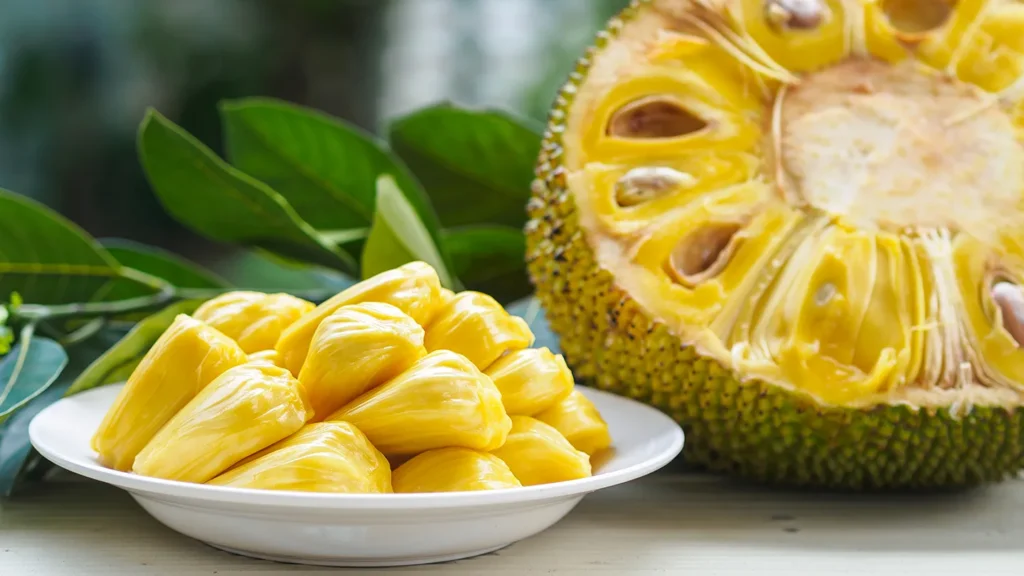
Jackfruit is a popular tropical fruit enjoyed in many countries across Asia, including Cambodia. While its sweet, yellow flesh is widely eaten, its seeds also contain interesting compounds that have attracted scientific attention. One of these is jacalin, a plant protein that researchers have studied for its interactions with human immune cells and its potential anti-HIV properties.
Although early laboratory research has produced intriguing findings, jacalin is not an approved HIV treatment, and eating jackfruit seeds has not been shown to prevent or cure HIV infection.
What Is Jacalin?
Jacalin is a type of plant protein known as a lectin. Lectins bind to particular sugar structures found on cells and other biological molecules. This ability makes them useful tools in laboratory research, particularly in studies of the immune system.
Researchers identified jacalin as a major protein in jackfruit seeds (Artocarpus heterophyllus). Because it interacts with certain immune cells and proteins, scientists have used it to investigate how cells communicate and how immune responses work.
A review published in the Journal of Immunological Methods in 1998 described jacalin’s biological properties and its applications in immunological research, including studies involving human immunodeficiency virus (HIV).
Read the scientific review: Jacalin: A Jackfruit Seed-Derived Lectin of Versatile Applications in Immunobiological Research.
What Did Researchers Discover About Jacalin and HIV?
One important study was published in the European Journal of Immunology in 1993. Researchers reported that jacalin could completely block HIV-1 infection in certain lymphoid cells under laboratory conditions.
The study investigated how jacalin interacted with CD4, a molecule found on the surface of certain immune cells. HIV-1 commonly uses CD4, together with other cellular receptors, to enter susceptible cells.
The researchers found that jacalin’s effects were more complex than simply preventing the virus from attaching to CD4. They also investigated a short peptide derived from jacalin’s protein sequence and reported anti-HIV activity in laboratory experiments.
These findings suggested that jacalin and related molecules could provide useful information for developing or investigating potential antiviral approaches.
However, the research was conducted in laboratory settings. It did not demonstrate that eating jackfruit seeds could produce the same effects in the human body.
Read the original research: Inhibition of Human Immunodeficiency Virus Infection by the Lectin Jacalin.
Why Is This Research Important?
HIV attacks the immune system, particularly CD4 T cells, which help the body coordinate its response to infections. Without effective treatment, HIV can progressively damage immune function.
Understanding how HIV interacts with human cells is important for developing treatments that interfere with different stages of the viral life cycle.
Jacalin is scientifically interesting because it interacts with cell-surface molecules and has demonstrated biological activity in laboratory experiments. Research involving proteins such as jacalin can help scientists investigate the complex relationships between viruses, immune cells, and cellular receptors.
Nevertheless, identifying a promising biological effect is only an early step in medical research. Scientists must establish whether a substance works reliably, whether it is safe, how it behaves in the human body, and whether its benefits outweigh its risks.
Jacalin has not been established as an effective HIV medicine for people.
Does Eating Jackfruit Seeds Protect Against HIV?
There is currently no reliable clinical evidence that eating jackfruit seeds prevents HIV infection or treats people living with HIV.
A major distinction exists between studying a purified protein in a controlled laboratory and consuming a whole food. When a person eats jackfruit seeds, the protein is exposed to digestion and may be broken down. The amount that reaches the bloodstream or relevant immune cells, if any, cannot be assumed to match the concentrations used in laboratory experiments.
Cooking and food preparation can also change the properties of proteins. Consequently, laboratory results involving purified jacalin cannot be directly translated into health claims about boiled, roasted, or otherwise prepared jackfruit seeds.
Jackfruit seeds may be eaten as food when properly prepared, but they should not be considered an antiviral supplement or a substitute for medical care.
What About Existing HIV Prevention and Treatment?
Effective HIV prevention and treatment methods are supported by extensive clinical evidence.
Antiretroviral therapy (ART) helps people living with HIV control the virus and protect their immune systems. When treatment successfully suppresses HIV to an undetectable level, the virus cannot be sexually transmitted—a principle commonly summarized as Undetectable = Untransmittable (U=U).
For people who may be exposed to HIV, prevention options include condoms, pre-exposure prophylaxis (PrEP), and post-exposure prophylaxis (PEP), depending on the circumstances. PEP must be started as soon as possible and within 72 hours of a potential exposure.
Anyone concerned about a possible HIV exposure should seek medical advice promptly rather than relying on food or unproven remedies.
For reliable information, visit the World Health Organization’s HIV fact sheet or the U.S. Centers for Disease Control and Prevention’s HIV resources.
Conclusion
Jacalin, a lectin protein found in jackfruit seeds, has attracted scientific interest because laboratory studies have reported activity against HIV-1 infection in certain experimental systems. This research helps scientists understand how proteins interact with immune cells and may inform future investigations into antiviral approaches.
However, these findings do not establish jacalin as a treatment or prove that eating jackfruit seeds can prevent or cure HIV. More evidence would be needed before any medical application could be recommended.
Jackfruit remains a food, while jacalin remains a subject of scientific investigation. People should continue to rely on proven HIV prevention methods, testing, and evidence-based treatment.