

Have you ever looked up at the night sky and noticed that the Moon sometimes appears as a thin crescent, sometimes as a half-circle, and sometimes as a bright, complete circle? This fascinating phenomenon has captured human curiosity for thousands of years.
Although the Moon appears to change its shape throughout the month, its actual shape remains nearly spherical. What changes is the portion of its sunlit surface that we can see from Earth.
This phenomenon is known as the phases of the Moon, and it occurs because the Moon orbits Earth while sunlight illuminates different portions of its surface from our perspective.
Understanding the Moon’s phases helps explain an important part of our solar system and shows how the movements of celestial objects influence what we observe in the sky.
According to NASA’s explanation of the Moon’s phases, the Moon does not produce its own light. Instead, it reflects sunlight, and its changing position around Earth determines how much of its illuminated side is visible to us.
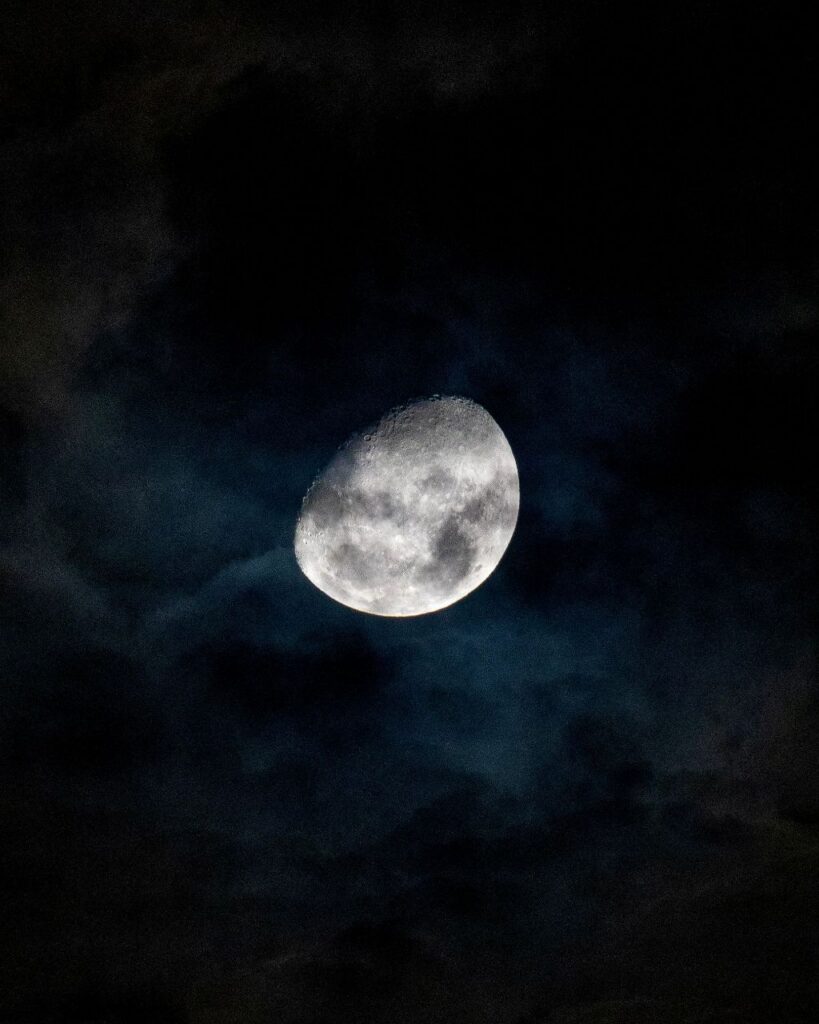
1. Does the Moon Really Change Its Shape?
The Moon does not physically transform from a circle into a crescent or a half-circle. It remains a roughly spherical natural satellite of Earth.
The Moon appears to change shape because the Sun illuminates approximately half of its surface at any given time. As the Moon moves along its orbit around Earth, our viewing angle changes, allowing us to see different portions of the illuminated half.
For example, when the Moon is positioned so that most of its sunlit side faces Earth, we see a full Moon. At another point in its orbit, only a small portion of the illuminated surface may be visible, creating a crescent shape.
During a new Moon, the side facing Earth receives little direct sunlight, so the Moon is generally difficult to see with the naked eye.
These changes occur in a regular cycle that repeats approximately every 29.5 days, measured from one new Moon to the next.
To explore this process visually, visit NASA’s guide to the phases of the Moon.
2. Why Does the Moon Change Its Appearance?
Three main factors explain why the Moon looks different throughout the month: sunlight, the Moon’s orbit around Earth, and our position as observers on Earth.
Sunlight Illuminates the Moon
The Sun is the primary source of natural light in our solar system. The Moon does not generate visible light of its own; instead, its surface reflects sunlight toward Earth.
At any given moment, approximately half of the Moon is illuminated by the Sun, while the other half is in darkness. The boundary between these illuminated and dark portions changes in appearance as the Moon moves through its orbit.
The Moon Orbits Earth
The Moon travels around Earth in an orbit that takes approximately 27.3 days to complete relative to distant stars. However, the complete cycle of lunar phases takes approximately 29.5 days because Earth is also moving around the Sun.
As the Moon changes position, the angle between the Sun, Earth, and Moon changes. Consequently, observers on Earth see different amounts of the Moon’s illuminated surface.
Our View From Earth Changes
The Moon’s appearance depends on how much of its sunlit side is visible from Earth.
This explains why the Moon can look like a narrow crescent one evening and appear much fuller several nights later. The Moon itself has not changed shape; we are simply seeing a different portion of its illuminated surface.
3. What Are the Eight Phases of the Moon?
Astronomers commonly describe eight phases of the Moon. These phases form a continuous cycle, moving from the new Moon to the full Moon and then back toward the next new Moon.
1. New Moon
During the new Moon phase, the Moon is positioned approximately between Earth and the Sun. The side illuminated by the Sun faces mostly away from Earth, making the Moon difficult or impossible to see under ordinary conditions.
A new Moon marks the beginning of the lunar phase cycle.
2. Waxing Crescent
After the new Moon, a small crescent of the illuminated surface becomes visible. Each day, the visible bright portion generally grows.
The word “waxing” means increasing, referring to the growing illuminated portion that we see from Earth.
3. First Quarter
During the first-quarter phase, approximately half of the Moon’s visible disk appears illuminated.
Despite its name, the Moon is not physically one-quarter illuminated. The term refers to the Moon completing approximately one-quarter of its lunar phase cycle.
4. Waxing Gibbous
Following the first quarter, more than half of the visible lunar disk appears illuminated. The Moon continues to look fuller as it approaches the full Moon phase.
The word “gibbous” describes a shape that is more than half illuminated but not yet completely full.
5. Full Moon
A full Moon occurs when the side of the Moon facing Earth is almost entirely illuminated by the Sun.
During this phase, the Moon generally appears as a bright circle in the night sky. It often rises around sunset and sets around sunrise, although exact times vary depending on location and the date.
Full Moons are especially noticeable because the illuminated surface is visible across nearly the entire lunar disk.
6. Waning Gibbous
After the full Moon, the illuminated portion visible from Earth gradually decreases.
This phase is called waning gibbous because more than half of the visible disk remains illuminated, even though the bright portion is shrinking.
7. Third Quarter (Last Quarter)
During the third-quarter phase, approximately half of the Moon’s visible disk appears illuminated again.
The Moon has progressed through roughly three-quarters of its lunar phase cycle, and the illuminated portion continues to decrease.
8. Waning Crescent
The waning crescent is the final phase before the next new Moon.
Only a thin crescent of the illuminated surface remains visible from Earth. The bright portion gradually becomes smaller until the cycle begins again.
For an illustrated overview of all eight phases, visit NASA Space Place’s guide to Moon phases.
4. How Long Does It Take for the Moon’s Phases to Repeat?
The complete cycle of lunar phases takes approximately 29.5 days, or slightly less than one calendar month.
During this period, the Moon moves through all eight commonly recognized phases. The transition between phases is gradual rather than instantaneous, so the Moon’s appearance changes a little from night to night.
The Moon’s orbital period around Earth is approximately 27.3 days relative to distant stars. However, because Earth also moves around the Sun, the Moon must travel a little farther before the same alignment between the Sun, Earth, and Moon occurs again.
That is why the phase cycle lasts approximately 29.5 days instead of 27.3 days.
This repeating pattern has helped people develop calendars, track seasons, and understand the passage of time throughout history.
5. Why Can We Sometimes See the Moon During the Day?
Many people associate the Moon with nighttime, but it can also be visible during daylight hours.
The Moon is not visible only at night. Its position in the sky depends on its orbit around Earth and its relationship with the Sun.
During certain phases, the Moon is above the horizon during the day. When the sky is clear enough, its illuminated surface can be seen against the blue sky.
For example, a first-quarter Moon is often visible in the afternoon, while a third-quarter Moon may be visible during the morning.
The Moon can be harder to notice during daylight because the bright sky reduces the contrast between the Moon and its surroundings. Nevertheless, it remains visible when its position and brightness allow us to distinguish it.
Its visibility therefore depends on the time of day, the lunar phase, atmospheric conditions, and the Moon’s position above the horizon.
6. Does Earth’s Shadow Cause the Moon’s Phases?
A common misconception is that Earth’s shadow causes the Moon to change shape.
In reality, the Moon’s phases are caused by changes in the relative positions of the Sun, Earth, and Moon. Earth’s shadow is not responsible for the ordinary monthly cycle.
Earth’s shadow does play an important role during a lunar eclipse. A lunar eclipse occurs when Earth moves between the Sun and the Moon in such a way that the Moon passes through Earth’s shadow.
During an eclipse, the Moon may become noticeably darker or take on a reddish appearance.
However, lunar eclipses do not happen every month because the Moon’s orbital plane is tilted relative to Earth’s orbit around the Sun. Most full Moons pass above or below the shadow cast by Earth.
The distinction is important: lunar phases occur regularly throughout the month, while lunar eclipses occur only when the necessary alignment takes place.
7. Why Is Understanding the Moon’s Phases Important?
Learning about the Moon’s phases helps people understand the relationship between Earth, the Moon, and the Sun.
For centuries, lunar cycles have been used to develop calendars and organize cultural, religious, and agricultural activities. Different societies have also used observations of the Moon to track time and recognize recurring astronomical patterns.
Today, studying lunar phases remains useful in astronomy education and in planning observations of the night sky.
Understanding these phases can also help people distinguish ordinary astronomical events from unusual phenomena. For example, a crescent Moon is not evidence that the Moon is physically breaking apart or changing its shape.
Instead, it is a predictable result of the Moon’s orbit and the way sunlight reaches its surface.
Observing the Moon regularly is a simple way to develop scientific curiosity. By recording its appearance over several weeks, students and families can see the pattern for themselves and gain a better understanding of how objects move in space.
Conclusion
The Moon appears to change shape because we see different portions of its sunlit surface as it orbits Earth. Its actual shape remains nearly spherical, and sunlight is responsible for the brightness that we observe from our planet.
The eight lunar phases—from the new Moon and waxing crescent to the full Moon and waning crescent—form a repeating cycle that takes approximately 29.5 days.
Understanding this phenomenon also helps explain why the Moon can sometimes be seen during daylight and why Earth’s shadow causes lunar eclipses but does not cause the ordinary phases.
The next time you look at the night sky, take a moment to observe the Moon. Whether it appears as a thin crescent or a bright full circle, its changing appearance offers a fascinating demonstration of the movements and relationships that shape our solar system.
The Moon does not change its shape throughout the month. What changes is how much of its sunlit surface we can see from Earth.